Learning the violin in Singapore can feel confusing at first. Do you need to buy a violin before starting? Should you take private lessons, group classes or learn online? How often should you practise? And should you work towards music examinations or simply learn for enjoyment?
The simplest way to start is to focus on three things: choose the right way to learn, start with a suitable and properly set-up violin, and build a consistent practice routine.
You do not need previous musical experience to begin. Children and adults can both learn the violin, but building the correct posture, bow hold, left-hand position, rhythm and listening skills from the beginning makes later progress considerably easier.
Step 1: Choose the Right Way to Learn Violin
There is a large amount of violin information available through videos, apps and online tutorials. These can be useful supporting resources, but the violin is a very physical instrument. Small differences in posture, bow angle, violin position and left-hand placement can have a significant effect on how comfortably you play and the sound you produce.
For a complete beginner, receiving regular feedback from a violin teacher is particularly useful. A teacher can see and hear problems that are difficult to identify when practising alone.
Choose a Learning Format That Fits Your Routine
Depending on your schedule and learning preferences, violin lessons may be conducted in different ways:
- 1-to-1 violin lessons provide individual attention and allow the lesson pace to be adjusted to the student.
- Group violin lessons can provide a more social learning environment and allow beginners to learn alongside other students.
- In-person lessons make it easier for the teacher to make detailed adjustments to posture, bow hold and playing position.
- Online violin lessons can offer additional flexibility for students who cannot regularly travel to a music school.
For most beginners, consistency matters more than trying to find a supposedly perfect learning format. Choose an arrangement that you can realistically maintain over the long term.
What Should You Look for in a Violin School?
A good violin programme should teach more than individual songs. Look for a structured learning path that develops the fundamentals progressively.
Beginner violin lessons should normally include areas such as:
- correct posture and violin hold;
- bow hold and bow control;
- left-hand position and finger placement;
- rhythm and basic note reading;
- intonation and listening;
- tone production;
- scales and technical exercises as the student progresses;
- repertoire appropriate to the student’s level;
- practice strategies between lessons.
The goal is not simply to finish pieces quickly. Strong foundations make more advanced techniques easier to learn later.
If you want to understand these skills in more detail, read our guide to the fundamentals of violin technique, including posture, bow control, left-hand technique, fingering and tone production.
You can also explore how LVL structures its violin lessons in Singapore for beginners, children, adults and more advanced students.
Step 2: Get the Right Violin Before You Practise Seriously
A beginner does not necessarily need an expensive violin, but the instrument does need to be the correct size, playable and properly set up.
This is important because a poorly fitted or badly adjusted violin can make basic techniques unnecessarily difficult. A beginner may assume the problem is their playing when the instrument itself is making bowing, fingering or tuning harder than it needs to be.
You Do Not Have to Buy a Violin Before Your First Lesson
If you have never played before, it can be sensible to have your teacher or an experienced violin specialist help determine the appropriate instrument before purchasing one.
This is particularly important for children because violins are available in different fractional sizes. The correct size depends on the player’s physical measurements rather than simply choosing an instrument based on age.
Adults will generally use a full-size violin, although individual circumstances can vary.
Rent or Buy?
Both options can make sense for beginners, but the right choice depends more on your level of commitment and circumstances than on the student’s age.
Renting can be useful for someone who wants to try the violin before purchasing an instrument, needs one for a shorter period, or is not yet ready to commit to buying.
Buying can make sense from the beginning for both children and adults who intend to continue learning. For younger students, needing a larger violin later does not necessarily mean renting is the better choice. At LVL, students can explore trade-in options when moving to a bigger violin size, allowing the instrument to be upgraded as the child grows.
Owning a violin also gives the student a consistent instrument to practise on, maintain and become familiar with as their playing develops.
If you are uncertain which option suits you, explore LVL’s violin rental options or browse the violin shop in Singapore.
Setup Matters as Much as the Label on the Violin
A beginner violin should allow the student to concentrate on technique rather than fighting against the instrument.
Important areas include the bridge, soundpost, strings, nut, pegs and general playability. Correct adjustment can influence tuning stability, response, string height and how comfortable the violin feels under the fingers.
If you are comparing instruments, our guide on how to choose a good violin explains what beginners should consider before buying.
Step 3: Build a Consistent Violin Practice Routine
A weekly lesson is only one part of learning the violin. Progress happens when the ideas introduced during the lesson are reinforced through regular practice at home.
For beginners, short and focused practice sessions are usually more useful than occasionally practising for a very long period.
A simple beginner practice session might include:
- Posture check: make sure the violin and body are positioned comfortably.
- Bow exercises: work on straight, controlled bow movement and an even sound.
- Left-hand exercises: practise finger placement and intonation slowly.
- Rhythm or note reading: reinforce what was covered during the lesson.
- Current piece: work on a small section rather than repeatedly playing the entire piece from beginning to end.
- Review: finish by revisiting something you can already play reasonably well.
Practise What Needs Improving, Not Only What You Enjoy Playing
One common beginner habit is repeatedly playing the easiest part of a piece while avoiding the difficult section. Effective practice works in the opposite direction.
Slow the difficult passage down, identify the actual problem and work on it separately. It might be rhythm, bow distribution, finger placement, intonation or coordination between the two hands.
Once that smaller problem improves, put the passage back into the complete piece.
Consistency Beats Rushing Through Grades
There is little benefit in reaching a particular violin grade quickly if fundamental technique has been skipped along the way.
Students progress at different speeds. A better measure of progress is whether posture is becoming more natural, the bow is easier to control, intonation is improving, note reading is becoming faster and increasingly difficult music can be approached more independently.
What Will You Learn in Your First Violin Lessons?
A complete beginner should not expect to start by playing difficult pieces. The early stages are about making the instrument feel increasingly natural and establishing techniques that can support future development.
Your first lessons may cover:
- the parts of the violin and bow;
- how to hold the violin comfortably;
- how to hold and control the bow;
- playing open strings;
- basic rhythm;
- left-hand finger placement;
- reading simple notation;
- producing a controlled and consistent sound;
- simple scales, exercises and beginner pieces.
These skills may appear basic, but they form the technical foundation for everything that follows.
How Much Do Violin Lessons Cost in Singapore?
The price of violin lessons varies according to factors such as the student’s level, lesson duration and whether the class is individual or group-based.
Rather than duplicating changing prices in this beginner guide, you can see LVL’s current rates and a fuller explanation in our dedicated guide to violin lesson fees in Singapore.
Price is naturally an important consideration, but it should not be the only one. Also consider the quality and consistency of the curriculum, the learning environment, whether the student receives useful feedback and whether the programme can continue supporting the student as they progress.
Do You Need to Take Violin Exams?
No. Violin examinations can provide useful milestones, but they are not compulsory in order to learn the instrument well.
Some students enjoy having clearly defined grade targets. Others learn for leisure, school orchestra, ensemble playing, personal enjoyment or performance without making examinations their main objective.
For students who choose the examination route, ABRSM’s official violin information covers Practical Grades and Performance Grades from Initial Grade through Grade 8.
A good learning programme should develop musicianship and technique rather than teaching only what is required to pass the next examination.
Learning Violin as a Child vs an Adult
Children Learning Violin
Young students often benefit from shorter, clearly structured activities and regular encouragement. Parents can help significantly by creating a regular practice routine at home without turning every practice session into a battle.
Correct violin sizing is also especially important because children may need to change instrument size as they grow.
Adults Learning Violin
Adults sometimes assume they have started too late. There is no requirement to have learnt violin as a child.
Adult beginners often have different goals from younger students. Some want to play favourite pieces, some are returning to music after many years, while others want a structured challenge outside work.
The important part is setting a realistic pace. An adult with limited practice time may progress differently from a student who practises every day, but both can make meaningful progress.
How Long Does It Take to Learn Violin?
There is no single useful answer because “learning the violin” can mean very different things.
Being able to play a simple beginner piece is very different from developing reliable intonation, confident bow control, shifting, vibrato, advanced repertoire or orchestral skills.
Instead of asking how quickly you can finish learning the violin, it is more useful to think in stages:
- Foundation: posture, bow hold, rhythm, basic fingering and note reading.
- Control: improved tone, intonation, bowing and coordination.
- Independence: learning increasingly difficult music with less assistance.
- Musicianship: phrasing, interpretation, ensemble skills and confident performance.
The violin is an instrument that can continue developing with you for many years. There is no need to rush the process.
A Practical Beginner Violin Journey
If you are starting from zero in Singapore, a sensible sequence is:
- Decide why you want to learn the violin.
- Choose a lesson format that fits your weekly routine.
- Have the correct violin size confirmed before buying an instrument.
- Make sure the violin is properly set up and playable.
- Learn posture, bow hold and left-hand position correctly from the beginning.
- Practise regularly between lessons.
- Build technique progressively instead of rushing through repertoire.
- Perform, join ensembles or take examinations when these goals become useful to your development.
Starting Your Violin Journey at LVL Music Academy
LVL Music Academy provides structured violin lessons for children and adults in Singapore, from complete beginner foundations through more advanced study, examinations and performance preparation.
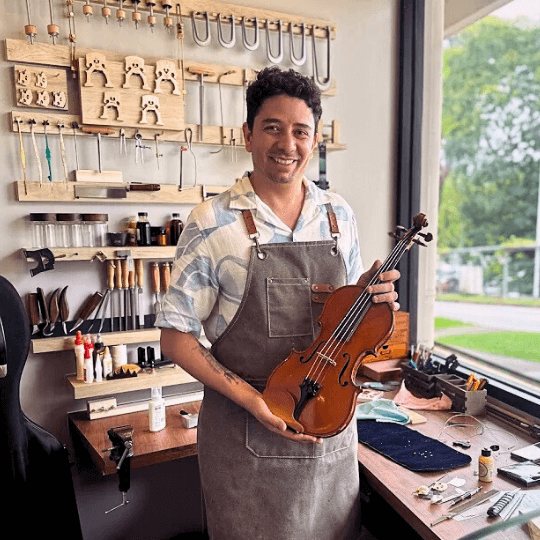
Students can also receive guidance on violin sizing, rental and instrument selection. Because LVL combines its music school, violin shop and in-house luthier workshop, the learning and instrument sides of the violin journey can be supported in one place.
If you are completely new to the violin, you do not need to purchase an instrument before your first lesson. Start by finding the right learning approach and instrument for your situation, then build from there.
Frequently Asked Questions About Learning Violin in Singapore
Can I learn violin with no musical experience?
Yes. Beginner violin lessons can start from the fundamentals, including posture, bow hold, rhythm, note reading and basic finger placement. Previous musical training can help, but it is not required.
Do I need to own a violin before my first lesson?
No. In fact, beginners may benefit from having the correct violin size confirmed before purchasing an instrument, particularly when the student is a child.
Can I teach myself violin?
Videos and online resources can be useful for revision and additional learning. However, beginners can benefit significantly from direct feedback because posture, bow movement, intonation and hand position are difficult to assess accurately by yourself.
Is violin difficult to learn?
The violin requires coordination, listening and consistent practice, particularly because there are no frets showing exactly where the fingers should be placed. That does not mean it is unsuitable for beginners. A structured progression makes the early stages much more manageable.
Is it too late to learn violin as an adult?
No. Adults can begin violin at any age. The lesson pace, repertoire and goals can be adjusted according to the student’s schedule and reason for learning.
Should beginners buy or rent a violin?
Either can work. Rental can reduce the initial commitment and is useful when a growing child may need a different violin size later. Buying may make more sense for students who intend to continue and want their own instrument. The most important point is that the violin is correctly sized and properly set up.
Do I have to take ABRSM violin exams?
No. Exams are optional. Students can learn violin for leisure, performances, school ensembles or personal development without following a graded examination route.
Ready to Start Learning Violin?
The best first step is not buying the most expensive violin or trying to progress as quickly as possible. It is building the right foundation.
Choose a learning environment that suits you, start with a properly sized and set-up instrument, practise consistently and allow your technique to develop progressively.
Explore violin lessons at LVL Music Academy or visit our violin shop in Singapore if you need help choosing your first instrument.