
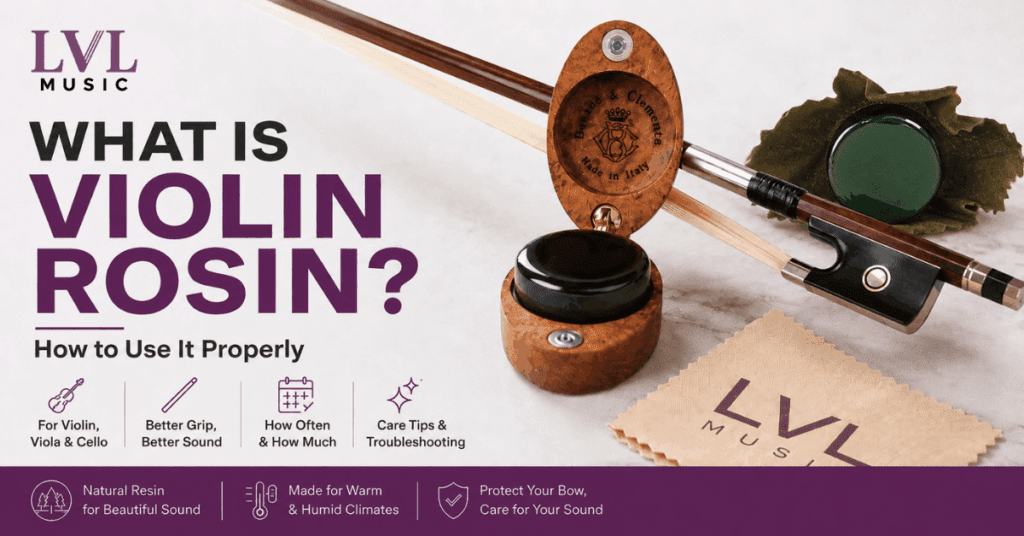
Updated for 2026
Rosin is one of the smallest items in a violin case, yet it plays an essential part in producing a clear, controlled sound. Without enough rosin, bow hair struggles to grip the strings. With too much, the bow can feel rough and leave unnecessary residue on the instrument.
The important part is not simply remembering to apply rosin. It is understanding how much your bow needs, how to distribute it properly, and how different formulations affect the playing experience.
This guide explains what violin rosin is, how it works, how to apply it to new and used bow hair, how often to use it, and how to choose between violin, viola and cello rosins. We also compare selected products available through LVL Music, including 050Rosin, Jade, CECILIA, Pirastro and Bogaro & Clemente.
If you already know what you need, you can browse the LVL Music rosin collection .
Quick Guide
Violin Rosin: The Essentials in 30 Seconds
| Your question | The practical answer |
|---|---|
| What does rosin do? | Helps bow hair grip and release the string, allowing it to vibrate. |
| How do I apply it? | Use light, even passes along the playing length of the bow hair. |
| How often should I apply it? | When the bow begins to lose reliable grip, not automatically before every session. |
| How much is enough? | Enough for a clear, predictable response without excessive powder or scratchiness. |
| Does a new bow need more? | Usually, if the hair has not already been rosined by the bow maker or workshop. |
| Is dark rosin always better? | No. Colour alone does not reliably describe grip, hardness or quality. |
| Can violin rosin work on a viola? | Sometimes, but an instrument-specific formulation may provide a better response. |
| What should I do after playing? | Wipe fresh rosin residue from the strings and instrument with a suitable dry cloth. |
What Is Violin Rosin?
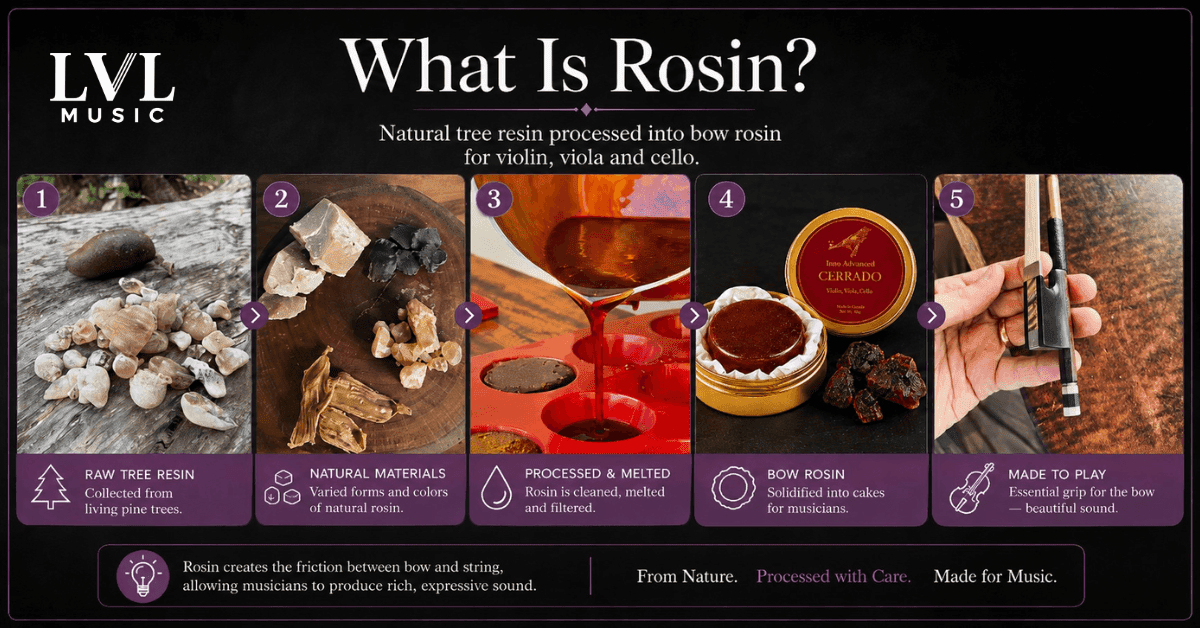
Violin rosin is a solid material applied to bow hair to increase friction between the hair and the strings. Traditional rosin is produced from natural tree resin, commonly from pine and other coniferous trees. During processing, volatile components are removed, leaving a solid resin-based material that can be prepared for use by musicians.
Rosin is also known as colophony. Different makers use different formulations and production methods, which is why two cakes of rosin may feel and perform differently even when they appear similar.
A typical cake is hard and somewhat brittle. It can crack or shatter if dropped, so it should be handled carefully and stored in its protective cloth, holder or container.
The important distinction
Rosin is not a lubricant for the bow. Its purpose is to create controlled friction. That friction is what helps the bow set the string into motion.
Why Does a Violin Bow Need Rosin?
Most traditional violin bows use horsehair. Untreated bow hair generally cannot create enough reliable friction against a violin string for normal bowed playing.
Rosin changes the interaction between the hair and string. As the player draws the bow, the string is briefly carried along by the hair before slipping back. This repeated stick–slip motion produces the sustained vibration that the violin body amplifies into sound.
For a more technical explanation, see the University of New South Wales explanation of bowed-string motion .
Rosin is therefore important for much more than volume. The amount and character of the grip can influence how easily a note begins, how the bow responds at different speeds and pressures, and how confidently the player can articulate passages.
Insufficient grip
The bow may slide without speaking clearly. Notes can sound weak, airy or inconsistent, particularly at quiet dynamics.
Controlled response
The hair engages the string reliably, allowing clear articulation and a predictable response across the bow.
Excess residue
The bow may feel unnecessarily aggressive, while loose powder collects on the strings and instrument.
Step-by-Step
How to Apply Rosin to a Violin Bow Properly
Applying rosin is straightforward, but the technique matters. The aim is to distribute a thin, reasonably even layer across the part of the hair that contacts the strings.
-
Prepare the bow
Tighten the bow hair to a normal playing tension. The hair should be sufficiently taut for controlled application, without overtightening the stick.
-
Hold the rosin securely
Keep the cake in its cloth, holder or case where possible. Avoid touching the playing surface with oily fingers.
-
Start with gentle contact
Place the rosin against the hair near the frog. Use a light, steady movement rather than pressing the hair forcefully into the cake.
-
Cover the full playing length
Move towards the tip in smooth, controlled passes. Make sure the middle and upper sections receive attention rather than repeatedly rubbing only one area.
-
Check the response
Play a few sustained notes and gentle attacks on each string. If the bow still slips, add a little more rosin and test again. Stop when the response becomes reliable.
-
Put the rosin away safely
Return the cake to its protective container and keep it away from direct sunlight, heat and accidental impact.
Application Tip
There is no single correct number of strokes for every bow. A recently rosined bow may need very little, while fresh, unrosined hair may require considerably more preparation. Let the bow’s response guide you.
How to Rosin a New Violin Bow or a Freshly Rehaired Bow
New or freshly rehaired bow hair may arrive with little or no rosin on it. In that condition, the first application can take longer than routine maintenance because the rosin needs to become distributed through the hair ribbon.
First, check whether the bow maker or workshop has already prepared the hair. If the bow has been pre-rosined, begin with a normal playing test rather than automatically applying a heavy coating.
For genuinely unrosined hair, work patiently along the entire playing length with repeated light passes. Test the bow on the strings at intervals. Continue only until the hair provides dependable grip.
Some players scratch or roughen the surface of a new rosin cake. This is not normally necessary. Aggressive scratching can create loose fragments, damage the cake and encourage uneven application. If the surface is unusually hard or glossy, follow the maker’s instructions rather than improvising with sharp tools.
If fresh hair still refuses to take rosin after careful preparation, ask the workshop that rehaired the bow to check it. The answer is not always to keep adding more powder.
How Much Rosin Should You Use, and How Often?
One of the most common beginner questions is whether rosin should be applied before every practice session. Not necessarily.
The correct frequency depends on playing time, bow hair condition, the formulation, string type and how much rosin remains on the hair. A bow used for several hours of demanding playing will not have the same needs as one used for a short beginner practice.
| What you notice | What to do |
|---|---|
| The bow speaks clearly and feels consistent. | Keep playing. You may not need more rosin. |
| Soft notes are becoming unreliable or the bow slips. | Try a small, even application and test again. |
| Large amounts of powder appear after a few strokes. | Stop adding rosin and clean the instrument after playing. |
| The bow remains slippery despite repeated applications. | Check the hair, strings and technique rather than endlessly adding rosin. |
| The bow feels unusually harsh immediately after rosining. | Allow the excess to work off through normal playing; avoid another application. |
Beginners should develop the habit of checking the bow’s response rather than applying rosin by the calendar. Teachers can help students recognise the difference between insufficient grip and a bowing-technique problem.
Why Does My Violin Still Sound Scratchy or Slippery?
Rosin can affect response, but it is only one part of the bow–string relationship. If the violin sounds rough or refuses to speak clearly, identify the actual cause before changing products.
| Symptom | Possible cause | Useful first step |
|---|---|---|
| Bow slides across the string. | Insufficient rosin, poor hair condition or unsuitable bow contact. | Apply a little rosin and test a slow, steady bow stroke. |
| Sound is harsh or gritty. | Excess rosin, too much bow force or an unsuitable contact point. | Check technique and avoid adding more rosin automatically. |
| One string responds poorly. | Dirty or worn string, uneven setup or bowing issue. | Inspect and clean the string carefully. |
| Rosin collects rapidly on the violin. | Heavy application or a formulation that sheds more visible residue. | Reduce application and wipe the instrument after playing. |
| Rosin no longer improves the bow. | Contaminated, worn or uneven bow hair. | Have the bow assessed for cleaning or rehairing. |
A good bow also depends on balance, camber, hair quality and the condition of its fittings. If you are assessing the bow itself, read our guide to choosing a violin bow .
How to Choose the Right Violin Rosin
Rosin selection is often reduced to light versus dark, or beginner versus professional. Neither distinction tells the whole story.
A better starting point is to consider the instrument, the strings, the bow hair and the type of response you want. Manufacturers may develop different formulations to emphasise stronger grip, smoother bow changes, clearer articulation or a particular playing feel.
Instrument
Start with rosin recommended for violin, viola, cello or your specific historical instrument.
Strings
Gut, synthetic-core and steel strings can feel different under the bow. Follow any relevant string-maker guidance.
Response
Decide whether you need more reliable initial contact, smoother changes or greater control at soft dynamics.
Playing Conditions
Temperature, storage conditions and playing intensity can influence how a particular formulation feels.
Light Rosin vs Dark Rosin: Which Is Better?
Traditional descriptions often associate lighter rosins with a firmer or drier feel and darker rosins with a softer or tackier feel. These can be useful general tendencies within some product ranges, but they are not universal rules.
Colour does not reliably identify the ingredients, hardness, grip or quality of a modern rosin. Two dark cakes from different makers may behave very differently, and a lighter formulation can still provide strong contact with the string.
A Better Way to Compare
Use one rosin consistently for several playing sessions, keeping the same bow and strings. Pay attention to the beginning of the note, bow changes, soft playing and the amount of residue. Changing several parts of the setup at once makes comparison difficult.
Does More Expensive Rosin Sound Better?
Not automatically. More expensive products may use specialised formulations, distinctive manufacturing methods or premium packaging. What matters is whether the rosin gives your particular bow and strings the response you need.
If you are also considering a string change, use our violin strings comparison guide to understand how string construction, response and tension affect the overall playing experience.
Violin Rosin vs Viola Rosin vs Cello Rosin
All three instruments use rosin to create controlled friction, but their strings, bow dimensions and playing demands differ. That is why specialist makers offer separate violin, viola and cello formulations.
| Instrument | What to consider | Practical starting point |
|---|---|---|
| Violin | Clear articulation, controlled response and grip across four strings. | Begin with a violin-specific or clearly compatible multi-instrument rosin. |
| Viola | Reliable engagement on thicker, lower-pitched strings without losing nuance. | Consider a viola formulation or a product explicitly recommended for viola. |
| Cello | Secure string contact and controlled response across a wider range of bow forces. | Start with a cello-specific formulation. |
| Viola da gamba | Compatibility with historical playing technique and the instrument’s string setup. | Choose a product specifically approved for the instrument. |
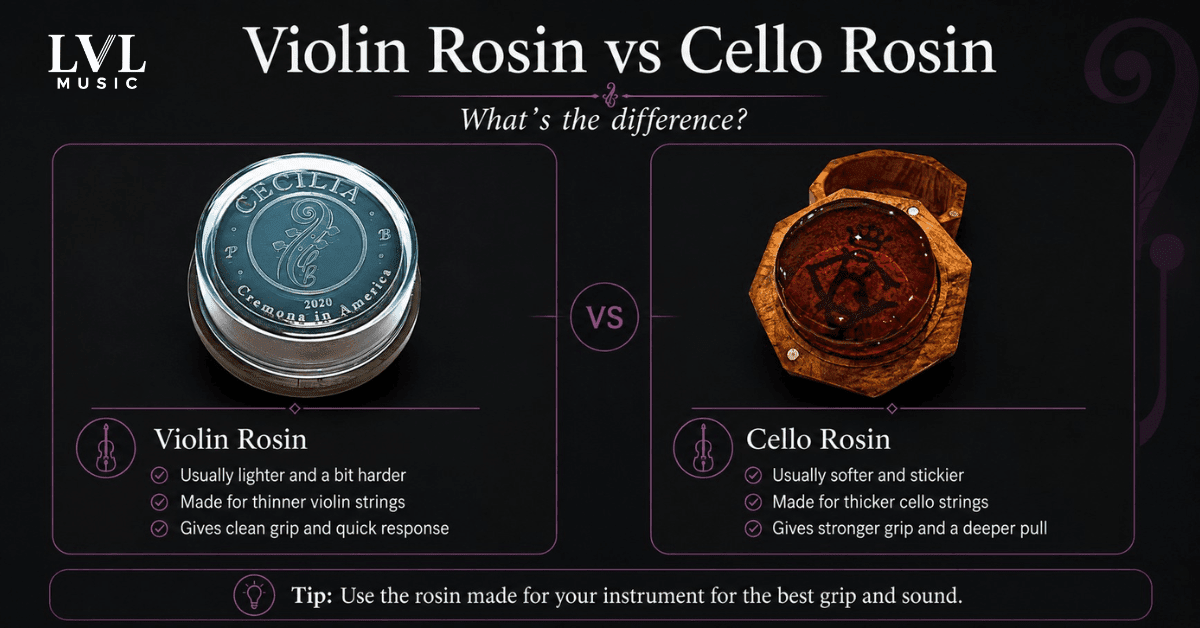
Using a violin rosin on a viola or cello is not automatically harmful, but it may not give the most suitable response. Check the maker’s instrument recommendations instead of assuming every rosin is universal.
LVL Music Rosin Selection
Seven Rosins Worth Comparing
The products below cover violin, viola, cello, viola da gamba and selected multi-instrument applications. Rather than ranking them from best to worst, the aim is to show what each product is designed for and help you make a sensible shortlist.
Violin · 050Rosin
050Rosin Violin Rosin
Handmade in Groningen, Netherlands, this violin-specific formulation is presented as offering dependable grip, clarity and a round, resonant tonal character.
Worth considering if: you want a dedicated violin rosin suitable for gut, synthetic or steel strings.
View 050Rosin Violin RosinViola · 050Rosin
050Rosin Viola Rosin
A dedicated viola formulation, also handmade in Groningen. Its stated character emphasises firm bow contact, clear articulation and a warm, rounded sound.
Worth considering if: you play viola and want a formulation designed for its lower register and expressive bow response.
View 050Rosin Viola RosinCello & Viola da Gamba · 050Rosin
050Rosin Cello & Viola da Gamba Rosin
Developed with cellist Jacopo Ristori and inspired by a historical formulation. Designed for clear articulation and a full, resonant response on cello and viola da gamba.
Worth considering if: you want a rosin specifically intended for cello or viola da gamba, including gut-string applications.
View 050Rosin Cello & GambaViolin, Viola & Cello · Jade
Jade L’Opéra Rosin J100M
A multi-instrument option listed for violin, viola and cello. It is supplied mounted on a protective cloth and kept in a container for storage.
Worth considering if: you prefer a rosin offered for several bowed instruments rather than choosing a separate cake for each one.
View Jade J100M RosinViolin · CECILIA
CECILIA SOLO Violin Rosin — Half Cake
CECILIA’s SOLO formula is positioned around strong grip, projection and clear articulation. This mini version offers the violin formulation in a smaller cake.
Worth considering if: you are looking for an assertive, clearly articulated bow response, especially in more demanding playing.
View CECILIA SOLO MiniViolin · Pirastro
Pirastro Evah Pirazzi Gold Violin Rosin
Developed to complement Pirastro’s Evah Pirazzi Gold strings. Pirastro emphasises clear articulation, controlled response at softer dynamics and relatively low dust formation.
Worth considering if: you use Evah Pirazzi Gold strings or want to explore a rosin designed for precise, responsive violin playing.
View Evah Pirazzi Gold RosinItalian Rosin · Bogaro & Clemente
Bogaro & Clemente PAGANINI Rosin
A traditional Italian rosin made from needle resin and presented in a handcrafted oval wooden case with a magnetic closure.
Worth considering if: you value a protective, distinctive presentation alongside the playing characteristics of the rosin. Confirm the correct instrument variant before ordering.
View PAGANINI RosinBefore You Buy
These descriptions reflect the intended use and published positioning of the products, not a claim that one rosin will produce the same result on every instrument. The bow, strings, technique and setup still matter.
Compare the Full Range
Explore More Rosins at LVL Music
Compare available violin, viola, cello and specialist rosins in the LVL Music shop.
Singapore Players
Does Singapore’s Hot, Humid Climate Affect Violin Rosin?
Singapore’s warm, humid environment is worth considering when storing and using rosin. Some formulations can feel softer or tackier when exposed to higher temperatures, while prolonged heat can affect the condition of the cake.
However, humidity and temperature do not make one colour of rosin universally correct for Singapore. A darker rosin is not automatically more heat-resistant, and a lighter one is not automatically more suitable.
Practical storage habits are more important than choosing by colour alone:
- Keep the rosin in its case or protective wrapper.
- Avoid leaving it inside a parked car or in direct sunlight.
- Do not place the cake beside a window or other heat source.
- Protect it from drops and crushing inside the instrument case.
- Allow the instrument and accessories to adjust gradually when moving between air-conditioned and warmer spaces.
Climate management is also part of caring for the instrument itself. Our violin care and maintenance guide covers everyday cleaning and storage considerations.
How to Clean Rosin Dust and Care for Your Bow
Cleaning Rosin Residue from the Violin
After playing, gently wipe fresh rosin dust from the strings and the instrument’s surface using a clean, soft, dry microfibre cloth. Pay particular attention to the area around the bridge and the strings where residue collects.
It is useful to keep a separate cloth for the strings and another for the varnished body. This reduces the chance of transferring accumulated residue across the instrument.
Avoid household cleaners, alcohol and other solvents on the varnish. If residue has become hardened or difficult to remove, have it assessed professionally rather than scrubbing or scraping the surface.
Should You Clean the Bow Hair?
Avoid touching the hair with your fingers, as skin oils can interfere with its ability to hold rosin. Do not wash the hair or apply cleaning liquids without guidance from a qualified bow technician.
Bow hair gradually wears and can become contaminated. If the bow has lost consistent grip despite sensible rosining, a professional rehair may be more useful than trying another cake.
How Long Does a Cake of Rosin Last?
There is no fixed expiry date that applies to every formulation. A properly stored cake can remain useful for a considerable time, while one exposed to heat, dirt or repeated impact may deteriorate sooner.
Replace it if the playing surface has become heavily contaminated, the cake has broken into impractical pieces or its performance has clearly deteriorated. A small surface crack alone does not always mean the rosin is unusable.
What About Rosin Dust and Sensitivity?
Rosin dust can irritate some people. Avoid deliberately creating airborne powder, clean residue regularly and do not assume that a product described as low-dust is necessarily allergen-free.
If ingredient sensitivity is a concern, obtain reliable formulation or safety information from the manufacturer before purchasing. Product descriptions such as “hypoallergenic” should not be treated as a guarantee for every individual.
Common Rosin Mistakes to Avoid
Applying rosin directly to the strings
Apply rosin to the bow hair, not to the violin strings or instrument body.
Using more whenever the sound is poor
Scratchiness can come from bow pressure, speed, contact point, strings or setup rather than insufficient rosin.
Scratching every new cake
Routine scoring with a blade or abrasive is generally unnecessary and can damage the rosin.
Changing rosin too frequently
Constantly switching products makes it difficult to understand what is improving or worsening the bow’s response.
Ignoring accumulated residue
Regular gentle cleaning is much easier than removing old, hardened rosin from a violin.
Assuming a more expensive cake fixes everything
A worn bow rehair, dirty strings or unsuitable technique cannot always be solved by premium rosin.
For a broader overview of what belongs in a player’s instrument case, see our guide to essential violin accessories .
Frequently Asked Questions
Violin Rosin FAQs
Do I need to rosin my violin bow every day?
Not necessarily. Apply rosin when the bow begins to lose dependable grip. Playing time, the rosin formula and the condition of the hair all affect how frequently it is needed.
How many times should I rub rosin on the bow?
There is no universal number. Use a few gentle, even passes as a starting point for an already rosined bow, then test the response. New, unrosined hair usually needs more preparation.
Can I use cello rosin on a violin?
Some products may work across instruments, but cello-specific rosin can have a different playing feel. Follow the manufacturer’s recommendations and choose a violin-compatible formulation when possible.
Is light or dark violin rosin better?
Neither is automatically better. Colour can sometimes reflect formulation differences, but it is not a reliable standalone measure of hardness, grip or quality.
Why does my bow still slip after applying rosin?
Possible causes include uneven application, worn or contaminated hair, dirty strings or a bowing-technique issue. If careful application does not help, have the bow and strings checked.
Can I use two different rosins on the same bow?
Switching products is generally possible, but layering different formulations can make their effects difficult to judge. Use one consistently while testing it, and avoid unnecessary heavy applications.
Does rosin damage violin strings?
Rosin is a normal part of bowed-string playing. The main maintenance concern is excessive accumulation. Wipe the strings gently after playing and avoid abrasive cleaning methods.
When should I replace my violin rosin?
Replace it when it becomes badly contaminated, too damaged to use safely or noticeably ineffective. Age alone is not always a reliable reason to discard it.
Final Advice
Use Enough Rosin to Help the Bow — Not More Than It Needs
Good rosining is about balance. The bow should grip the string confidently, respond to soft and strong playing, and allow you to control articulation without creating unnecessary dust.
Start with a formulation suited to your instrument, apply it evenly, listen to the result and adjust gradually. If the bow still behaves poorly, consider the hair, strings and overall setup before assuming another rosin will solve the problem.
Find the Right Match
Choose Rosin That Works With Your Bow and Strings
Explore LVL Music’s selection of violin, viola, cello and specialist rosins, from versatile everyday options to instrument-specific formulas.