
Updated for 2026
Choosing a violin bow is not simply a choice between Pernambuco, carbon fibre and Brazilwood. The material matters, but so do the bow’s balance, stiffness, camber, mass distribution, horsehair and workmanship — and most importantly, how the individual bow works with your violin and your playing style.
A more expensive bow is not automatically easier to control, and a Pernambuco bow is not automatically better than a well-designed carbon-fibre or Brazilwood bow. Two bows made from the same material can feel remarkably different in the hand and produce different results on the same violin.
The most useful starting question is therefore: what do you want the bow to do better than your current bow?
If you already know what you are looking for, browse LVL’s violin bow collection to compare Brazilwood, Pernambuco and carbon-fibre bows from beginner through advanced and professional ranges.
How to Choose a Violin Bow in 30 Seconds
| Your priority | What to look for |
|---|---|
| First good bow for a beginner | A straight, predictable Brazilwood or carbon-fibre bow with sensible balance and good hair |
| Durability, travel or Singapore’s climate | A quality carbon-fibre stick is particularly practical |
| Traditional high-level wooden bow | Well-selected Pernambuco from a reputable maker, tested on your own violin |
| Your bow feels heavy or tiring | Check balance and mass distribution, not only total weight |
| Spiccato feels difficult or unpredictable | Compare camber, stiffness, balance and tip weight between bows |
| The bow feels sluggish at the start of a note | Look for quicker response and a stick that engages the string without excessive effort |
| Your current bow sounds thin or uninteresting | Test bows for tonal colour and connection on your own violin rather than buying by material alone |
| You are buying a used bow | Check straightness, camber, hair, frog, screw, tip and previous repairs before judging it |
Start With How the Bow Plays, Not What It Is Made From
Material is easy to put on a product label. Playing behaviour is more complicated.
A violin bow is an elastic system. The shape of the stick, where the mass is distributed, how strongly the stick resists bending, the camber built into it and the tension of the horsehair all influence what the player feels.
This is why two bows with similar specifications can behave very differently — and why two violinists can reasonably prefer different bows.
| If your current bow feels… | Pay attention to… |
|---|---|
| Sluggish or slow to speak | Response, stiffness, balance and how easily the hair engages the string |
| Heavy or tiring | Mass distribution and balance before assuming the total weight is too high |
| Nervous or difficult to control | Camber, stiffness and how predictably the stick settles on the string |
| Difficult in spiccato | Tip mass, balance, spring and natural rebound |
| Weak at the tip | Stick strength, camber and control in the upper third |
| Fine for legato but poor for articulation | Response to martelé, détaché and off-the-string strokes |
| Comfortable but tonally disappointing | How the particular bow interacts with your violin and strings |
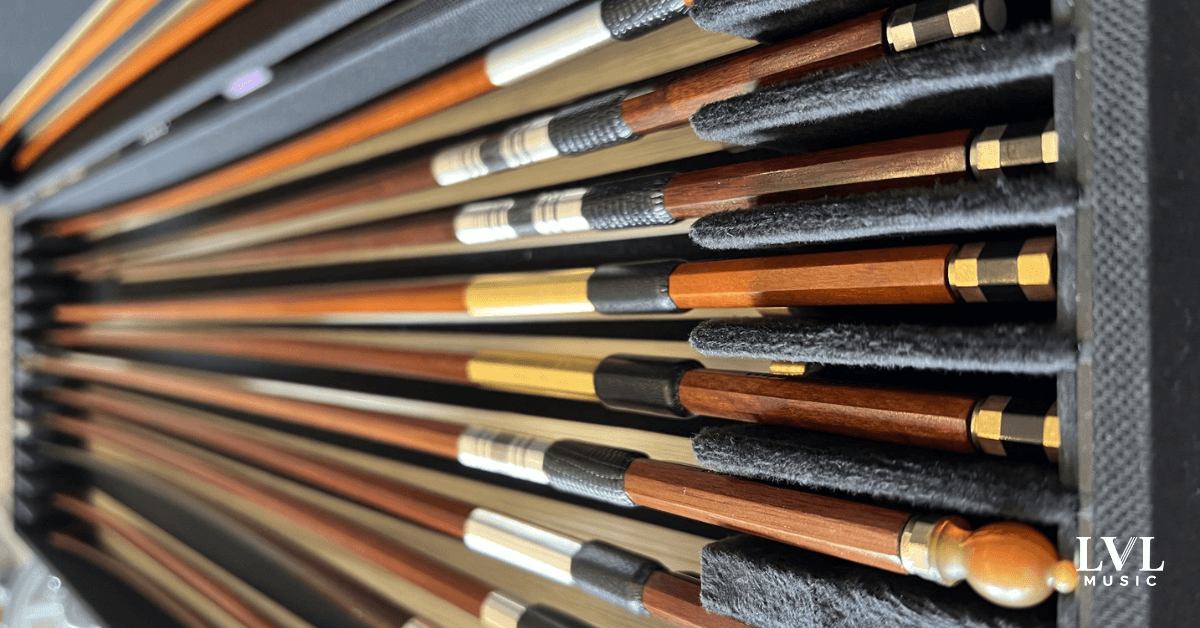
Pernambuco vs Carbon Fibre vs Brazilwood: The Real Differences
These are three of the most common material categories a violinist encounters when moving beyond the very cheapest student bows, but none of them describes a fixed level of performance.
Pernambuco
A traditional bowmaking wood valued for combining strength, elasticity and relatively low mass when suitable wood is selected and worked well.
Fine Pernambuco bows can offer exceptional control and tonal nuance, but the name of the wood alone does not guarantee a good bow.
Carbon Fibre
A manufactured composite that allows designers substantial control over stiffness, weight and construction.
Good carbon-fibre bows can be responsive, stable and highly refined, while inexpensive examples may be considerably simpler. Quality varies greatly.
Brazilwood
In modern bow retail, Brazilwood is best treated as a broad commercial wood category, not as a precise promise of species or playing quality.
It is commonly found in accessible student and intermediate bows, but carefully selected and well-made Brazilwood bows can extend far above basic student level.
| Material | Main strengths | Possible limitations | Good starting point for |
|---|---|---|---|
| Pernambuco | Traditional bowmaking material; potentially refined response, elasticity and tonal nuance | Large variation between individual sticks; higher cost; conservation and provenance considerations | Advancing, advanced and professional players who can compare individual bows carefully |
| Carbon fibre | Climate stability, durability and highly controllable engineering; can be very consistent | Construction and playing quality vary greatly between inexpensive and sophisticated designs | Beginners through professionals, travel, outdoor work and players wanting stability |
| Brazilwood | Wide price range, traditional wooden feel and many accessible options | The term covers varied wood and quality levels, so the label alone says relatively little | Students, advancing players and anyone who finds a particular wood bow that works well |
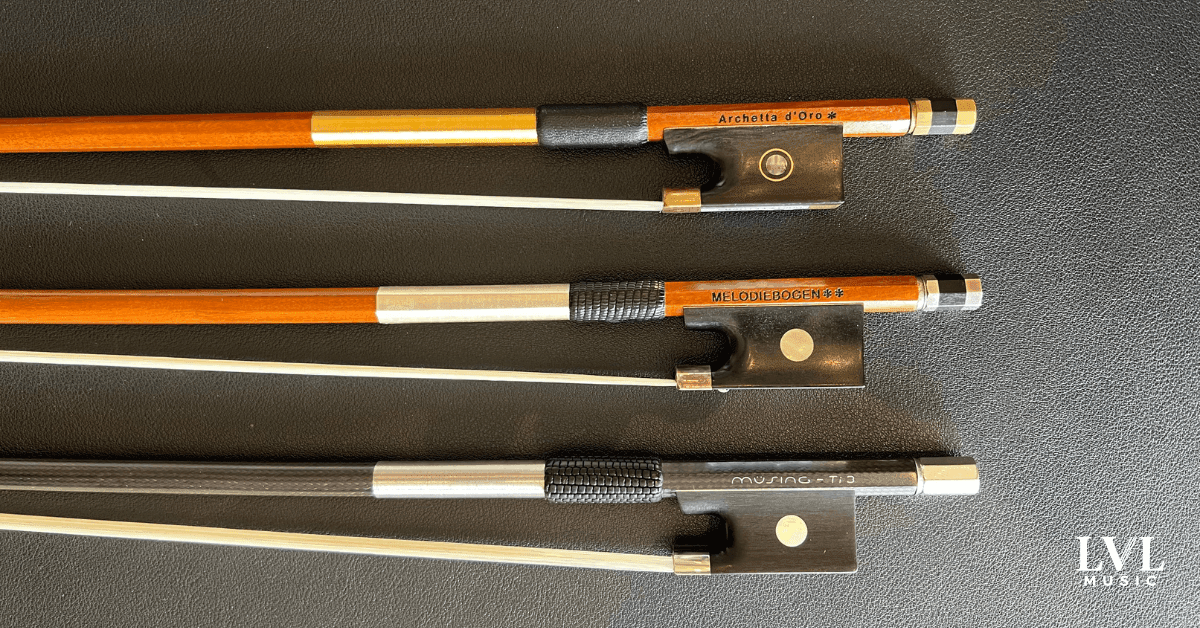
Pernambuco Violin Bows: Why the Wood Became the Traditional Standard
Pernambuco has a long association with high-level bowmaking because suitable pieces of the wood can combine strength, elasticity and density in a way that allows a skilled bow maker to create a strong but responsive stick.
The important phrase is suitable pieces. Wood is naturally variable. The quality of the blank, the maker’s graduation of the stick, the camber, the head, the frog and the final balance all matter.
A mediocre Pernambuco bow should therefore not be chosen simply because “Pernambuco” appears on the label. A better-designed carbon-fibre or Brazilwood bow may be a much better match for the player and violin.
Who should consider Pernambuco?
Pernambuco becomes especially interesting when the player is experienced enough to evaluate fine differences in articulation, rebound, dynamic control, tonal colour and behaviour at the frog and tip.
In LVL’s current range, examples include the Antique Silver-Mounted Violin Bow – Workshop of L. Bausch, Germany, c.1920 and the Michael Mönnig 10261 .
Pernambuco, conservation and international travel
Pernambuco comes from Paubrasilia echinata, or pau-brasil, a protected Brazilian species. International regulation has become more focused on provenance, traceability and legitimate trade.
Following CITES CoP20 in 2025, the international framework was updated to strengthen controls and traceability while clarifying conditions for legitimate non-commercial movement of musical instruments. Players travelling internationally with an older or valuable Pernambuco bow should therefore retain purchase and provenance documentation and check the requirements for their particular journey rather than relying on old travel advice.
For the current conservation background, see the Brazilian government’s 2025 pau-brasil conservation update .
Carbon-Fibre Violin Bows: Much More Than a Durable Student Alternative
Carbon-fibre bows should not be treated as one uniform category.
The lowest-cost carbon bow and a sophisticated hollow carbon-fibre bow may share a material name while being very different in construction, mass, stiffness and playing response.
One of carbon fibre’s biggest practical advantages is consistency. The stick itself is far less sensitive to humidity changes than a wooden stick, and manufacturers can engineer the structure to target particular combinations of strength, weight and response.
That makes carbon fibre especially worth considering for players who travel frequently, perform outdoors, teach all day, want a dependable second bow, or live in a humid climate such as Singapore.
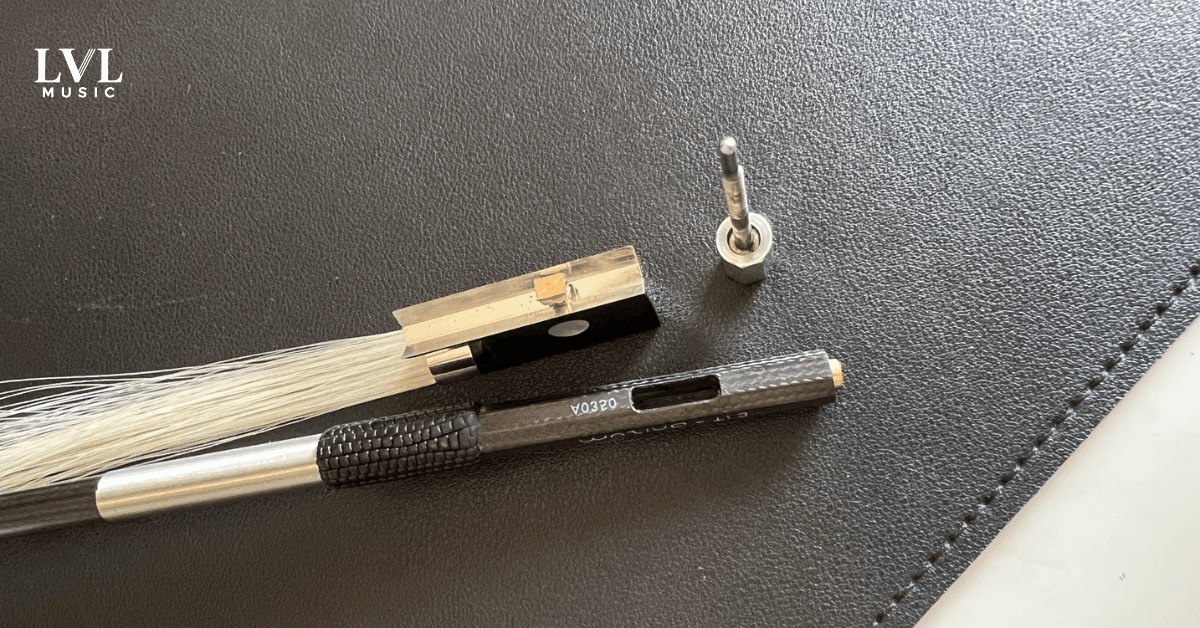
LVL Carbon Fiber Bow
A practical starting point for players who want the durability and stability of carbon fibre without immediately moving into a high-end engineered bow.
Müsing Ti3
A hollow carbon-fibre design aimed at players looking for greater precision, stability and refined control.
Brazilwood Violin Bows: Do Not Dismiss Them as “Beginner Only”
Brazilwood is frequently associated with student bows, and many affordable student bows do indeed fall into this category. That does not make “Brazilwood” a synonym for poor quality.
The term is broad, and makers can select, season and work different hardwoods to very different standards. Construction quality, straightness, camber, stiffness, frog fit and hair can all matter more than a simple material label.
This is especially relevant when moving from a very inexpensive beginner bow to a first serious upgrade. A well-balanced Brazilwood bow can sometimes give a developing player more useful control than an inexpensive bow purchased merely because it says carbon fibre or Pernambuco.
A useful entry and progression option
The LVL Brazilwood Violin Bow 2-Star is positioned as a progression bow for beginner-to-intermediate players and is available in fractional as well as full sizes.
Weight, Balance, Stiffness and Camber Matter as Much as the Material
Once you move beyond material labels, these are the characteristics that explain much of what the player actually feels.
Is 60 grams the ideal violin bow weight?
Many conventional full-size violin bows fall somewhere around the high-50s to low-60s grams, but there is no magic number that makes a bow good.
A relatively light bow can feel secure if its mass is distributed well. A heavier bow can feel surprisingly effortless if the balance suits the player. Conversely, a bow with an apparently normal total weight can feel cumbersome if too much mass is concentrated towards the tip.
This is why weighing the bow is useful information, but it is not a substitute for playing it.
Balance and mass distribution
Balance describes much more than locating a single point on the stick. What the player feels is the distribution of mass along the entire bow — including the head, stick, winding, leather, frog and button.
A tip-heavy bow may feel powerful but can require more work during fast off-the-string strokes. A bow with less tip inertia may feel more agile. Neither characteristic is automatically better; repertoire and playing style matter.
Stiffness and flexibility
A bow that is too soft for the player may collapse or feel unstable under stronger playing. A bow that is extremely stiff can feel precise but may become unforgiving if it does not suit the player or violin.
What matters is usable resistance: the stick should give the player something to work against without forcing unnecessary effort.
Camber
Camber is the deliberate curve built into the bow stick. It is a major part of how the bow behaves under hair tension and playing load.
Do not judge camber simply by asking whether the curve looks “deep”. The location and shape of the curvature, together with the stick’s taper and stiffness, are more important than one visual measurement.
Round vs Octagonal Violin Bows: Is One Better?
No. The cross-section alone is not a quality grade.
Both round and octagonal sticks can be found in inexpensive bows and in serious professional bows. Their behaviour depends on the material, dimensions, taper, camber and workmanship of the complete stick.
It is therefore misleading to buy an octagonal bow simply because somebody has described octagonal bows as automatically “stiffer” or “more professional”.
Bow Hair, Frog, Winding and Screw Matter More Than Most Buyers Think
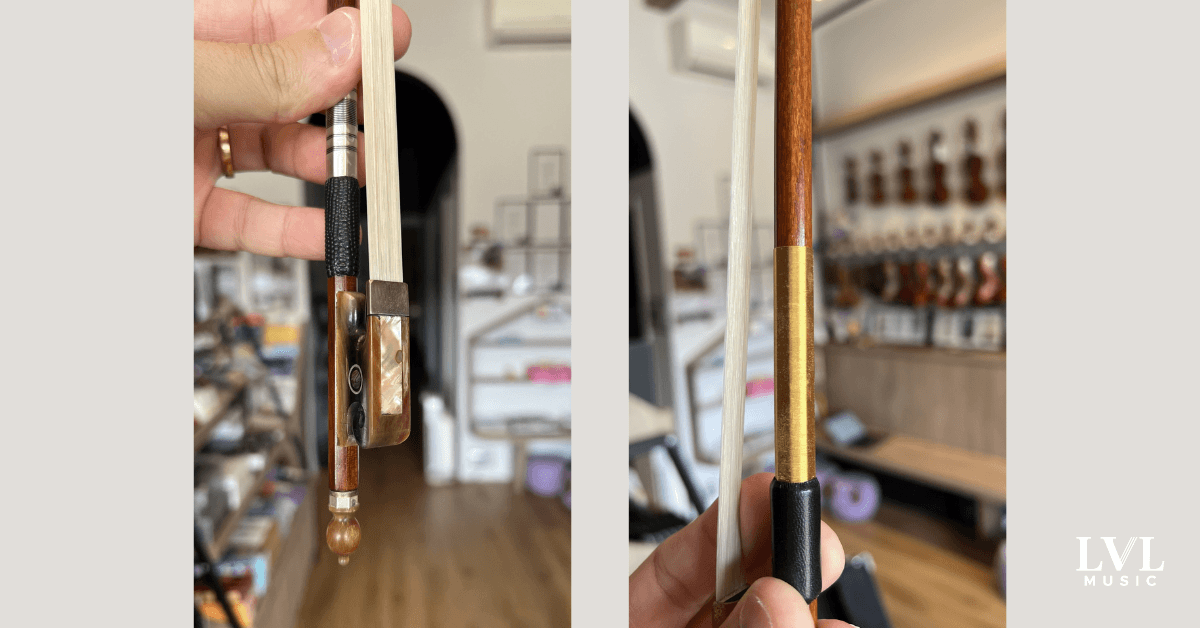
The stick attracts most of the attention when people compare bows, but a bow is a working system. The frog, horsehair, winding, thumb leather and screw mechanism all affect either its function, its mass distribution or the way it feels in the hand.
Horsehair
A very good stick with worn, dirty or uneven hair can feel disappointing. The hair ribbon should be reasonably even, properly fitted and able to take rosin and engage the string predictably.
When comparing a used bow, remember that poor hair can hide the quality of the stick. Sometimes a professional rehair is necessary before the bow can be assessed fairly.
Rosin is the interface that gives the hair sufficient grip on the strings. For application and maintenance advice, see our guide to violin rosin and how to use it .
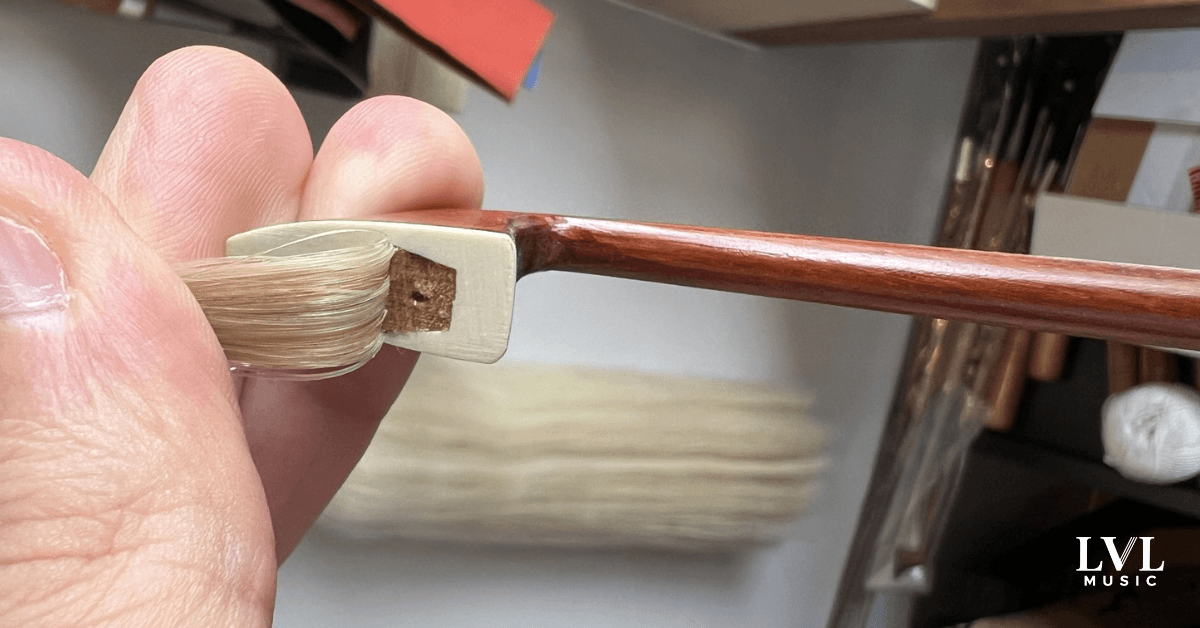
The frog and slide
The frog holds one end of the hair ribbon and moves along the stick as the screw is adjusted. Its fit should feel secure and precise rather than loose or erratic.
Ebony is common, while some bows use other materials. Pearl eyes and slides are traditional decorative and functional details, but decoration should never be confused with playing quality.
Silver, nickel and other fittings
Mounting material can indicate the level of finish and craftsmanship, but a silver-mounted bow is not automatically a better-playing bow than a nickel-mounted one.
Winding also contributes mass near the hand and therefore forms part of the complete balance of the bow. Changing winding is not purely cosmetic.
The screw and eyelet
The button at the end of a modern bow turns a screw that moves the frog and changes hair tension. It should turn smoothly without requiring excessive force.
If a screw binds, slips or becomes unusually difficult to turn, forcing it can make a relatively small maintenance problem more expensive.
How to Test a Violin Bow Properly
Specifications narrow the search. Playing the bow makes the decision.
Wherever possible, compare bows on the same violin, with the same strings and the same rosin. Changing the instrument or setup at the same time makes it difficult to know which difference you are actually hearing.
If you are also changing strings, first read our guide to choosing violin strings so that you are not evaluating two major setup changes at once.
Can you draw a sustained note smoothly from frog to tip without the bow feeling unstable?
Can the bow begin a quiet note cleanly without scratching or failing to engage?
Can you increase bow force without the stick feeling as though it collapses or loses control?
Does the bow change strings accurately without feeling cumbersome?
Does the bow rebound naturally at the tempo you actually use?
Can you create a clean, immediate start to the note while retaining control?
Does the bow remain useful at both extremes rather than feeling good only in the middle?
Have another player listen or record from several metres away, not only under your ear.
For explanations of basic bow strokes including legato, staccato, martelé and spiccato, see our fundamentals of violin technique .
Which Violin Bow Should You Choose for Your Playing Level?
Playing level can guide the shortlist, but it should not become a rigid material hierarchy.
| Player or use | Main priorities | Materials worth testing |
|---|---|---|
| Beginner | Straightness, durability, predictable response, sensible balance and correct size | Brazilwood and carbon fibre |
| Advancing student | Improved articulation, better rebound, more control at frog and tip | Better Brazilwood, carbon fibre and accessible Pernambuco |
| Advanced player | Response, tonal control, dynamic range, articulation and individual matching | Pernambuco and higher-level carbon fibre, plus any exceptional wood bow that works |
| Orchestral musician | Control, predictable articulation, dynamic range and reliable handling | All three, depending on violin and preference |
| Solo or audition use | Fine articulation, projection, tonal colour and broad dynamic control | High-level Pernambuco or carbon fibre after careful comparison |
| Outdoor / travel / second bow | Stability, durability and predictable behaviour | Carbon fibre is especially practical |
Children should also use a bow appropriate to the size of the violin. Do not give a young player a full-size bow merely because they may eventually grow into it.
A Good Bow Can Feel Bad When It Needs Maintenance
Before replacing a bow because it has become difficult to use, check whether the problem is actually the stick.
Old or contaminated hair, uneven hair loss, a worn thumb grip, a sticking screw or a poorly moving frog can all change the playing experience.
- Loosen the bow hair after playing.
- Do not repeatedly overtighten the hair to compensate for a maintenance problem.
- Avoid touching the playing surface of the hair unnecessarily.
- Keep rosin dust away from the stick and frog after playing.
- Do not force a screw that has become difficult to turn.
- Have the bow inspected if the stick is no longer straight, the frog is loose or the tip has been damaged.
- Rehair when the existing hair no longer provides an even, reliable playing ribbon rather than relying on one universal calendar interval.
Do not judge an expensive bow through worn-out hair
If a bow has good potential but poor hair, a proper rehair and mechanical check may reveal far more about its true playing quality than replacing it immediately.
Violin Bow Materials Compared
| Characteristic | Pernambuco | Carbon fibre | Brazilwood |
|---|---|---|---|
| Construction | Natural wood; quality depends heavily on selection and workmanship | Engineered composite; construction varies from basic to highly sophisticated | Natural hardwood category with substantial variation between makers and grades |
| Consistency between examples | Can vary considerably because every piece of wood is different | Potentially high within a well-controlled design | Can vary considerably |
| Climate stability | Wooden stick responds to environmental conditions | Excellent stick stability | Wooden stick responds to environmental conditions |
| Durability | Excellent when cared for, but should be protected from impact and poor storage | Usually a major practical strength | Depends on wood selection and construction |
| Potential playing level | Student through elite professional depending on the bow | Beginner through professional depending on the design | Most common at student/intermediate level but not confined to it |
| Best reason to choose it | You prefer the response and tonal behaviour of a particular well-made wooden bow | You want stability, durability and engineered performance | You find a well-balanced wood bow that offers the response and value you need |
| Main mistake to avoid | Assuming the material name guarantees quality | Assuming every carbon bow behaves alike | Assuming every Brazilwood bow is a basic beginner bow |
Current LVL examples worth comparing
Accessible wooden progression
A useful category for students moving beyond the most basic beginner bow.
Durability through advanced control
Compare a practical accessible carbon bow with a more sophisticated hollow-carbon design.
Traditional wooden refinement
Compare individual sticks carefully rather than selecting Pernambuco from the specification alone.
Your own violin
Whatever material you prefer, compare the finalists on your actual violin using the same passages.
Shop and Compare Violin Bows
Compare Brazilwood, carbon-fibre and Pernambuco bows across different price and playing levels. Use the specifications to create a shortlist, then judge the final bow by how it responds on your violin.
Browse All Violin BowsFrequently Asked Questions About Choosing a Violin Bow
Is a Pernambuco bow always better than a carbon-fibre bow?
No. Pernambuco is a traditional high-level bow material, but the quality of the individual stick and workmanship matters enormously. A good carbon-fibre bow can be more responsive, stable or better suited to a particular player than a mediocre Pernambuco bow.
Is carbon fibre better than Brazilwood?
Not automatically. Carbon fibre offers major advantages in durability and climate stability, while a good Brazilwood bow can provide a traditional wooden playing feel at an accessible price. Compare individual bows rather than choosing from the material name alone.
How much should a full-size violin bow weigh?
Many conventional full-size bows sit around the high-50s to low-60s grams, but there is no ideal weight that suits every player. Balance and mass distribution can make two bows of the same weight feel very different.
Is an octagonal bow better than a round bow?
No. Both shapes are used in bows at many quality levels. Material, dimensions, taper, camber and workmanship are more important than choosing a bow simply because the stick is round or octagonal.
How often should a violin bow be rehaired?
There is no single schedule that suits every violinist. Playing hours, climate, perspiration, rosin use and hair loss all matter. Rehair when the ribbon has become uneven, contaminated or unable to provide reliable grip despite normal rosining.
Can a beginner use a carbon-fibre violin bow?
Yes. Carbon fibre can be an excellent beginner material when the bow is straight, balanced and appropriately sized. Its durability and predictable stick behaviour are practical advantages for students.
Should I choose a bow by sound or by playing feel?
Both. A bow that produces a beautiful sound but fights your technique is not an ideal match, and a bow that feels effortless but produces a sound you dislike is also a compromise. The best bow gives you useful control while helping the violin produce the sound you want.
Can I travel internationally with a Pernambuco bow?
Legitimate non-commercial movement remains possible, but Pernambuco is a protected material and international rules have changed over time. Keep purchase and provenance documentation for valuable bows and verify the requirements for your destination before travelling.
Choose the Bow That Works With Your Violin and Your Right Hand
Start with material, but do not finish there. Compare balance, response, stiffness, camber, articulation, control at the frog and tip, and the sound the bow produces on your own violin.
The best violin bow is not necessarily the most expensive one or the one made from the most prestigious material. It is the bow that gives you greater control and allows your violin to respond more naturally to the way you play.